
If two swords are equally well designed, heat treated, assembled, and quality controlled, 1060’s higher carbon range gives the maker a different potential hardness and strength envelope than 1045. But the steel number does not tell you whether that potential was achieved. For a first sword, verify the maker’s heat treatment, measured hardness if available, blade geometry, construction, intended use, and warranty. A well-made 1045 sword can be a better purchase than a poorly made 1060 sword.
The short version: steel grade describes potential. Manufacturing turns that potential into the blade you actually receive.
 Grade is potential.
Process is outcome.
What do 1045 and 1060 mean?
1045 and 1060 are SAE carbon-steel grade designations. They are not quality scores, and they do not promise one exact carbon percentage. The current SAE J403 standard defines carbon-steel grades through chemical-composition ranges and recognizes product-analysis allowances.
A technical data book from steel producer Gerdau lists the following SAE-based ranges:
| Specification field | SAE 1045 | SAE 1060 | What it tells a sword buyer |
|---|---|---|---|
| Carbon, weight percent | 0.43-0.50% | 0.55-0.65% | 1060 begins with more carbon in the listed range |
| Manganese, weight percent | 0.60-0.90% | 0.60-0.90% | The grades overlap here |
| Finished-blade hardness | Not established by grade alone | Not established by grade alone | Ask for product-level evidence |
| Finished-blade toughness | Not established by grade alone | Not established by grade alone | Heat treatment and geometry matter |
| Safe intended use | Not established by grade alone | Not established by grade alone | Follow the maker’s written limits |
Source: Gerdau, Metallurgical Data Book. The chemistry table describes steel supplied to a specification. It does not certify a completed sword.
Does the extra carbon make 1060 automatically better?
No. The higher carbon range gives a heat treater a different set of possible outcomes, but “possible” is the important word.
Steel changes during a controlled sequence of heating, quenching, and tempering. The final microstructure helps determine hardness, strength, ductility, toughness, residual stress, and resistance to cracking. The ASM Handbook chapter on tempering identifies tempering temperature, time, carbon content, alloy content, and residual elements as variables that affect microstructure and mechanical properties. Tempering is also used to relieve quenching stresses and improve toughness and dimensional stability.
Experiments make the practical point clearer. A study of AISI 1045 under different heat treatments found that treatment and cooling rate materially changed hardness, strength, and toughness. Research on AISI 1060 with distinct heat-treated microstructures likewise found different material behavior after annealing and after quenching and tempering.
Those tests were not finished-sword comparisons, so they do not tell us that a particular 1045 or 1060 sword is better. They do establish why the grade label cannot carry the whole decision.
Why blade geometry belongs in the comparison
Two blades made from the same grade and treated to similar hardness can still feel and cut differently.
Thickness, distal taper, cross-section, edge angle, edge finish, mass distribution, and point of balance all change how a blade handles or meets a target. A peer-reviewed study of steel blades found that hardness, heat treatment, blade angle, and edge micro-geometry all influenced cutting performance. The test used knives rather than swords, so it supports the general geometry principle—not a numerical promise for a sword. See Materials, “A Comprehensive Understanding of Knife Cutting”.
Sword-specific research also connects blade behavior with more than bulk chemistry. A four-point bending study of Japanese swords discussed hardness, residual stress, microstructure, and specimen geometry when evaluating edge strength. See Journal of Alloys and Compounds, “Study of Japanese sword from a viewpoint of steel strength”.
This is why a product page that says only “1060 carbon steel” leaves important questions unanswered.
The first-sword buying checklist
1. Start with the intended use
Decide whether the sword is for display, forms practice, controlled cutting, or another activity permitted by the maker and your instructor or organizer. A sharp sword should never be treated as general sparring equipment. Neither 1045 nor 1060 makes an unknown sword safe for blade-to-blade contact or hard targets.
2. Look for a specific heat-treatment statement
“Heat treated” is only a starting point. A useful listing may identify whether the blade is through hardened or differentially hardened and may provide a measured hardness range. That information is still a maker claim unless test documentation is supplied, but it is more useful than an unsupported superlative.
3. Ask what the hardness number describes
A single HRC number can be misleading if it does not say where the measurement was taken, whether it is a target or measured range, or whether a differentially hardened blade has different edge and spine values. Do not copy a generic material-database hardness onto a finished product.
4. Check the blade and assembly specifications
Look for blade length, thickness, distal taper where available, weight, point of balance, edge condition, tang construction, and how the handle is secured. “Full tang” does not prove that the assembly, geometry, or heat treatment is good; it is one construction detail.
5. Read the use limits, return policy, and warranty
A trustworthy product page should make the intended use understandable and provide a path for inspection, return, or warranty support. If a seller makes strong performance claims but gives no use limits or remedy for defects, the steel number should not reassure you.
A practical decision tree
Choose the better-documented sword first. If one seller explains heat treatment, blade dimensions, assembly, intended use, and warranty while the other gives only a steel number, the documented option is easier to evaluate.
If documentation is comparable, inspect the manufacturing evidence. A credible hardness range, consistent specifications, maker reputation, and a clear inspection or return process matter more than a one-step grade ranking.
If two products are genuinely comparable in process and construction, use the grade as a tie-breaker. In that controlled comparison, 1060’s higher carbon range may suit a maker’s desired hardness and strength balance. It still does not guarantee the outcome.
If the intended use is unclear, pause the purchase. Ask the maker or seller before using a sharp sword. Do not infer contact safety from “battle ready,” “hand forged,” “full tang,” 1045, or 1060.
How to read a real Sword N Armory listing

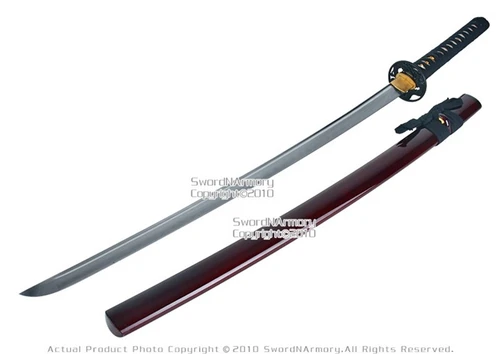
For example, the current Handmade Musashi 1060 Katana Samurai Sword Dragon Brown listing identifies 1060 carbon steel, differential hardening, blade length, weight, point of balance, double mekugi, and a stated edge hardness. Those are the kinds of fields a buyer should look for.
This article does not independently certify the listing’s metallurgy, hamon, hardness, assembly quality, or safe use. Confirm current specifications and written use limits with the seller before purchase or use. The product is an example of how to read disclosed fields, not proof that every 1060 sword—or this specific sword—is superior to a 1045 sword.
Common marketing shortcuts to ignore
- “1060 is always better.” The grade does not reveal the finished heat treatment, geometry, or assembly.
- “1045 cannot be functional.” That universal claim is not established by the accepted evidence.
- “Battle ready.” This phrase is not a material test or safety certification.
- “Full tang means indestructible.” Tang construction is only one part of the system.
- “Hand forged means higher quality.” Process language needs measurable, product-specific support.
- A precise HRC with no context. Ask whether it is measured, where it was measured, and whether it is a range.
Frequently asked questions
Is 1060 automatically harder than 1045?
Not as a finished sword. 1060 has a higher specified carbon range, but final hardness depends on heat treatment and must be established at the product level.
Can 1045 make a functional sword?
The grade alone cannot answer that. A useful evaluation needs heat treatment, geometry, construction, assembly, intended use, and quality-control evidence. Avoid both “1045 is always enough” and “1045 is never functional.”
Is a 1060 sword better for beginners?
Not automatically. A beginner benefits more from clear intended-use guidance, consistent manufacturing, inspectable specifications, appropriate handling characteristics, and a real return or warranty process.
What hardness should a sword have?
There is no single responsible number for every sword. Appropriate hardness depends on steel, heat-treatment strategy, geometry, construction, and use. Compare product-specific values only when the measurement and context are clear.
Does “full tang” prove a sword is safe to use?
No. It describes one aspect of construction. It does not certify the steel, heat treatment, geometry, handle assembly, defect inspection, or suitability for a particular activity.
Which one should I buy?
Buy the sword with the clearest credible evidence for its intended use. When two products are otherwise genuinely comparable, the steel grade can become a useful tie-breaker—but it should not be the first or only filter.
Sources and scope
The technical sources above support chemistry ranges and the general effects of heat treatment, microstructure, hardness, residual stress, and geometry. They do not provide a head-to-head test of two otherwise identical commercial 1045 and 1060 swords. That limitation is why this guide gives a verification framework instead of declaring a universal winner.
Safety note: Sharp swords can cause severe injury. Use only within the maker’s written limits, follow qualified instruction and site rules, wear appropriate protective equipment, maintain a controlled area, and never use a sharp sword for unsupervised contact practice or against hard targets.
Shop by disclosed specifications
Start with intended use, then compare the evidence behind the product.