
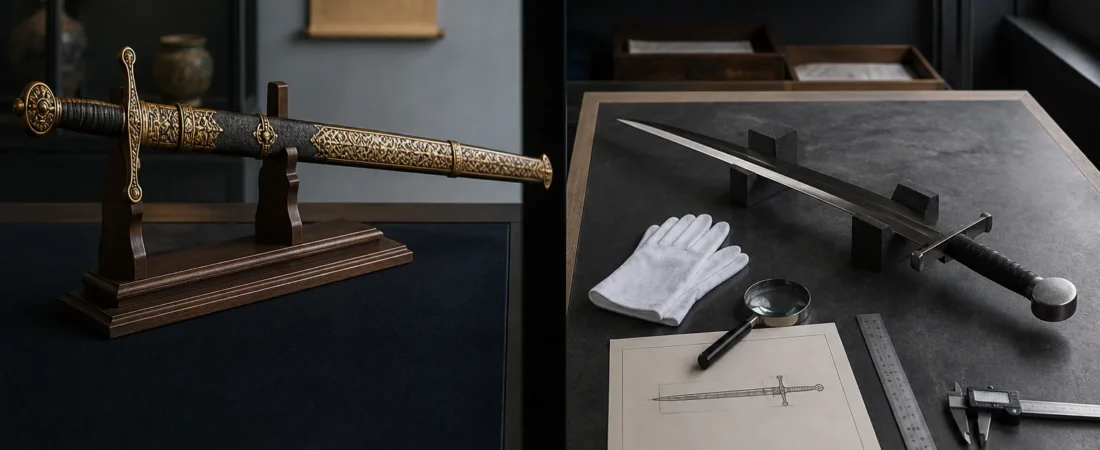
Direct answer: “Battle-ready” is a marketplace label, not a universal certification. Before buying, verify the exact sword’s intended use, blade material, heat-treatment information, tang and handle assembly, edge condition, maker instructions, and warranty. When a listing classifies a sword as display-only or decorative, treat it as intended for presentation, collecting, costume, or prop use—not impact, sparring, or test cutting—unless the manufacturer explicitly documents another activity for that exact model.
That distinction is about the individual product and documented activity, not whether a sword looks historic, is handmade, is expensive, or contains a particular word in its title.
Safety note: A sword can cause severe injury whether it is sharp or blunt. Do not swing, cut with, spar with, modify, sharpen, or disassemble one unless the maker permits that activity and a qualified instructor or organized activity provides the appropriate supervision, space, equipment, and rules.
Quick comparison
| Question | Display-only / decorative sword | Sword documented for a specific physical activity |
|---|---|---|
| Primary purpose | Display, collecting, costume, ceremonial, or prop use | A named activity such as solo forms, supervised test cutting, reenactment, or sparring |
| Impact/contact | Assume no impact or contact unless the maker explicitly says otherwise | Only the activity and contact level the maker and event rules permit |
| Edge and point | May be sharp, blunt, or false-edged; none of these alone proves construction quality | Must match the activity—cutting and contact training require very different designs |
| Construction evidence | Often limited to dimensions and appearance | Should identify material, heat-treatment information where supplied, assembly, dimensions, edge condition, intended use, and limits |
| Training choice | Not a trainer | Use the trainer type required by your instructor, club, school, or event rules |
| Buyer default when details are missing | Display only | Do not infer suitability; ask the seller or manufacturer |
What “battle-ready” does—and does not—tell you
“Battle-ready” is a marketplace label. Sword N Armory will not use the phrase as a substitute for product evidence or as a promise that a sword is safe for combat.
The phrase by itself does not establish:
- a shared certification or pass/fail test;
- suitability for sparring, reenactment, test cutting, martial-arts forms, or self-defense;
- a particular steel, hardness, heat treatment, tang shape, edge, or point;
- freedom from defects or the ability to withstand abuse;
- compliance with a club, event, insurer, carrier, venue, or local law.
If a listing gives the label but not the intended activity and supporting specifications, treat the activity as unknown.
Construction signals to verify
No single feature proves that a sword is suitable for use. Treat these as evidence fields to verify together.
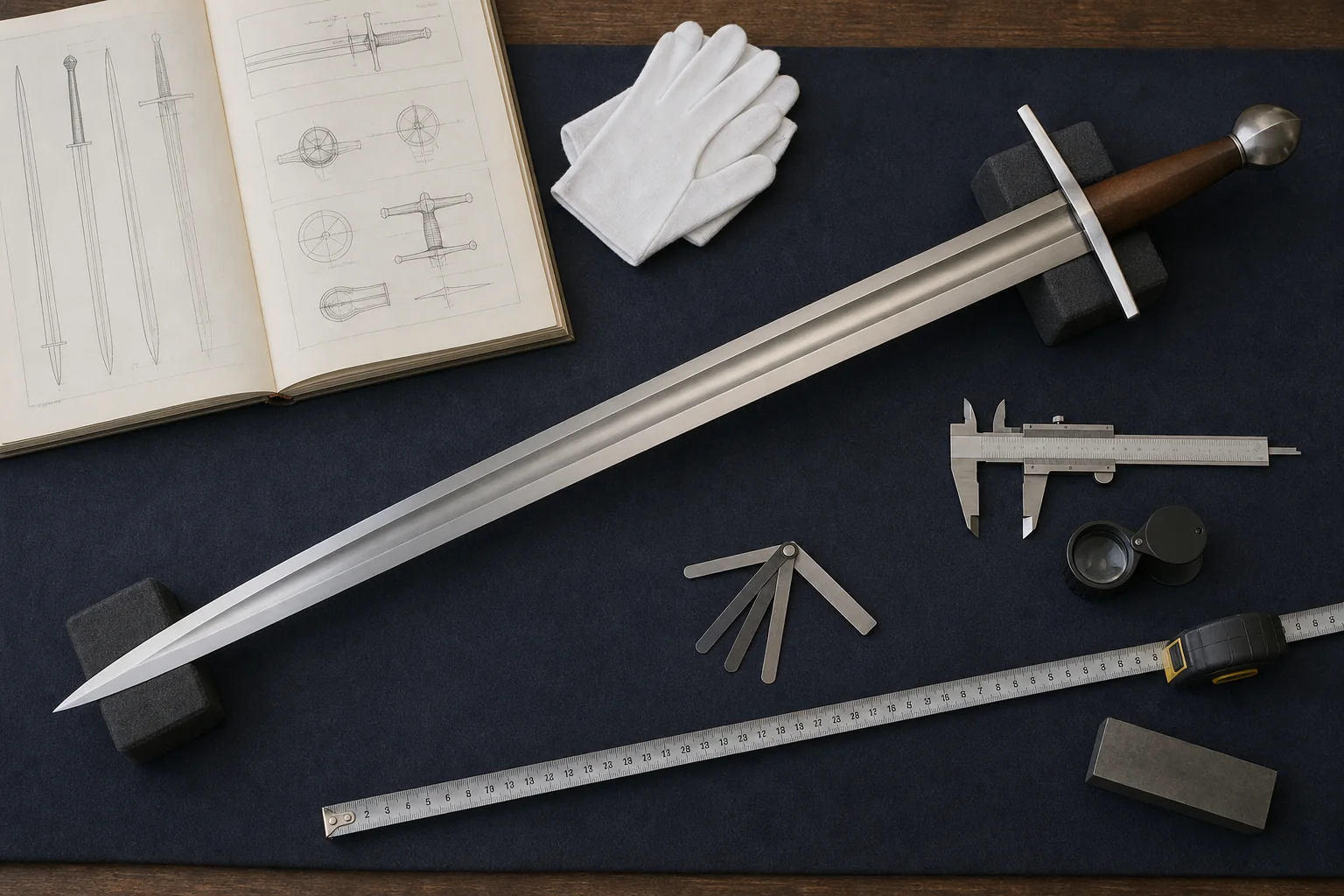
1. Intended use, stated in plain language
Look for a manufacturer statement that names what the model is designed for and what it is not designed for. “Functional,” “real,” “combat,” and “battle-ready” are less useful than statements such as “blunt trainer for this rule set” or “sharp sword intended for supervised cutting of approved targets.”
CAS Iberia’s official use guidance, for example, tells owners to confirm that a model is designed for the proposed activity and to seek competent instruction. That is the level of use-specific documentation buyers should look for.
2. Blade material and heat-treatment information
A steel designation describes material composition; it does not report the achieved properties of a finished blade. Heat treatment and the finished geometry also matter. The U.S. National Bureau of Standards’ technical monograph on iron and steel explains that heat treatment changes steel properties and relates strength to the achieved condition—not just the alloy name. Steel type alone is not a use classification: do not assume every decorative sword is stainless steel or that a non-stainless blade is suitable for physical use.
Ask for the exact steel designation and whatever heat-treatment information the maker supplies. If those fields are absent, record them as unknown rather than filling the gap with assumptions.
3. Tang and handle assembly
Ask how the blade continues into the handle, how the hilt is secured, and what inspection or maintenance the maker permits. Do not rely on “full tang” alone. CAS Iberia notes that the knife-industry meaning of full tang is often applied imprecisely to swords; traditional sword constructions can use other full-length assembly methods.
The useful question is not “Does it say full tang?” It is “What exactly is the assembly, and is it documented for the intended activity?”
4. Edge, point, blade geometry, and condition
A sharp edge does not prove impact suitability. A blunt edge does not make a sword harmless or automatically suitable for contact. Training organizations specify different edge, point, flexibility, inspection, and protective-equipment requirements for different activities.
Before every permitted use, follow the maker’s and activity organizer’s inspection rules. Stop using a sword if you find looseness, cracking, severe bends, burrs, or other damage, and seek qualified assessment.
5. Maker documentation and warranty
Read the exact model instructions and warranty before purchase. A warranty can exclude misuse, poor maintenance, disassembly, or using a sword as another tool. Cold Steel’s warranty, for example, excludes misuse and warns against using a knife or sword as an axe, prybar, or similar tool. Other makers set different limits.
Match the sword to the activity
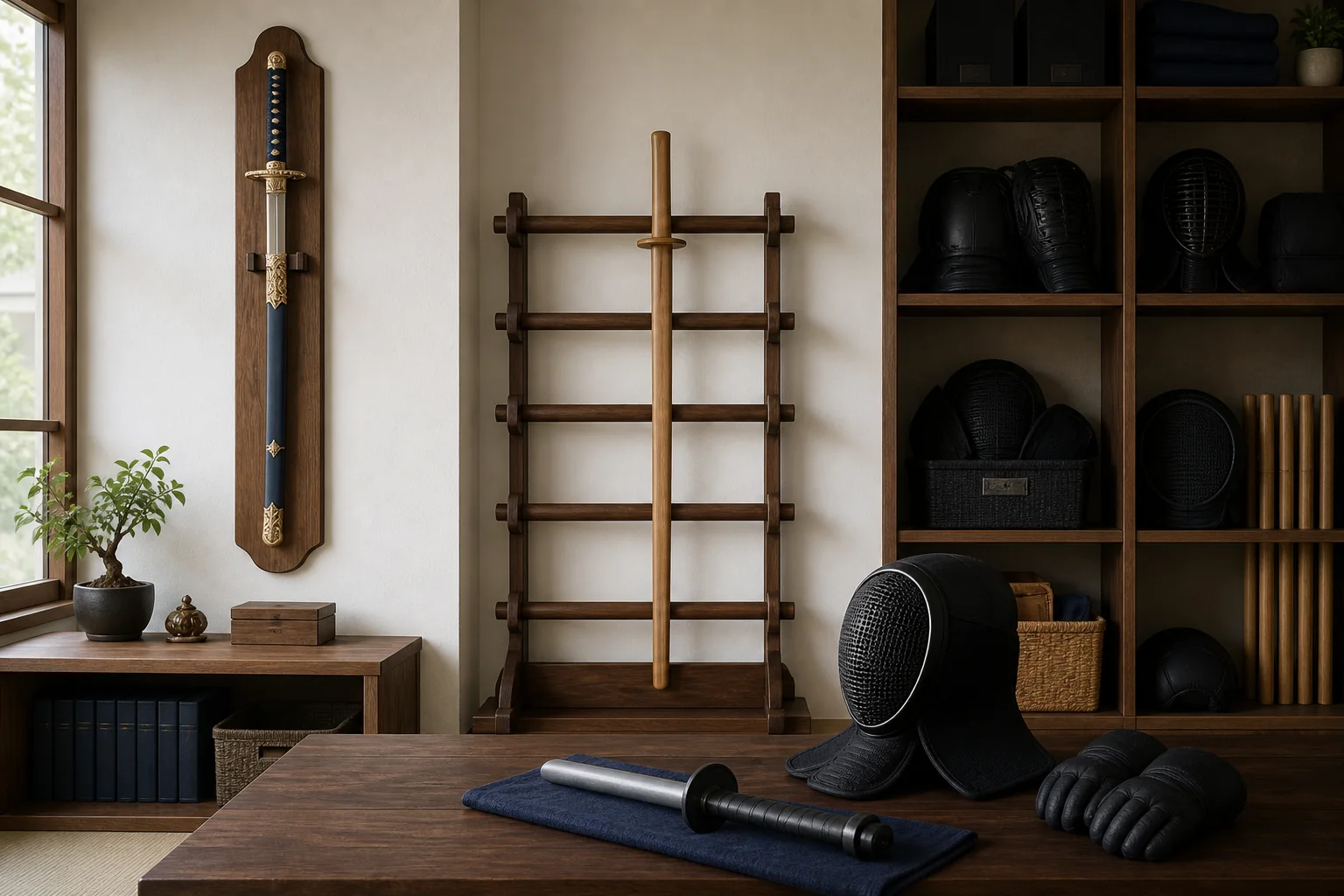
Display, costume, and collecting
Choose a product whose listing explicitly permits the intended display or costume use. Consider secure storage, a stable mount or stand, household access, local rules, edge condition, weight, and whether the venue allows the item. A display-only or decorative sword may still be sharp, heavy, pointed, or capable of causing injury.
Browse the broad Sword N Armory sword category or handmade sword category, but do not infer intended use from the category name alone.
Forms and solo practice
Use only the trainer type approved by the instructor or school. The British Kendo Association describes a progression from wooden swords to blunt alloy iaito in organized iaido and places restrictions and supervision around sharp swords. That illustrates why a marketplace label cannot replace discipline-specific instruction.
SNA’s polypropylene training sword and wooden practice sword categories are starting points for discovery, not declarations that every item is appropriate for every drill.
Sparring and reenactment
Do not use a sharp sword. Use a purpose-built trainer that meets the exact club or event rules, including edge, point, flexibility, condition, protective equipment, and permitted intensity. The HEMA Alliance safety policy distinguishes trainer and protective-equipment requirements by weapon and activity; organized rules control, not the term “battle-ready.”
Test cutting
Use only a model whose manufacturer explicitly permits the activity and targets, with competent instruction and a controlled area. CAS Iberia’s sword-use guidance recommends activity-specific models, appropriate targets, inspection, and training, and warns against hard, unyielding targets. Never “test the limits” of a sword.
Red flags in a listing
Pause before buying if a listing:
- says only “battle-ready,” “combat-ready,” “real,” or “functional” without naming an intended activity;
- treats one steel grade, a sharp edge, “handmade,” “forged,” or “full tang” as complete proof;
- promises that a sword is unbreakable, indestructible, or safe for any target;
- omits the maker, model, material designation, assembly, edge condition, dimensions, care instructions, or warranty;
- encourages striking trees, concrete, metal, another sharp sword, or other hard objects;
- uses the same product for display, cutting, sparring, reenactment, and self-defense without explaining different requirements;
- gives technical numbers without a test method, source, product record, or revision date.
Safety, law, maintenance, and warranty
- Instruction: Ask a qualified instructor for activity-specific guidance. Organized sword arts use supervision, spacing, risk assessment, protective equipment, and equipment inspection.
- Environment: Keep people, pets, fragile objects, and bystanders out of the working area. Never rely on “blunt” or “display” as meaning harmless.
- Law and venue rules: Ownership, carrying, transport, import, display, and use rules vary. Check current state and local government requirements, venue policies, carrier rules, and event rules. This guide is not legal advice.
- Maintenance: Follow the exact maker’s instructions. Materials and finishes can require different products. SNA’s sword-maintenance category is a supply directory, not a substitute for model-specific instructions.
- Warranty: Confirm what activities, targets, modifications, disassembly, sharpening, and maintenance the warranty allows before use.
The SNA product-disclosure standard
Before Sword N Armory treats a product page as evidence for a use claim, the page should disclose these fields or mark them not supplied:
| Field | Required disclosure |
|---|---|
| Intended use | Display, costume, ceremonial, solo forms, supervised cutting, reenactment, sparring, or another specifically named activity |
| Explicit exclusions | Activities and targets the product is not designed for |
| Manufacturer and model | Identifiable maker/brand and model or SKU |
| Blade material | Exact supplied designation—not merely “steel” |
| Heat treatment | Supplied process/result, or “not supplied” |
| Tang and handle assembly | Construction description supplied by maker or verified product record |
| Edge and point | Sharp/blunt/unsharpened status and point condition |
| Dimensions and weight | Product-specific measurements, with source |
| Instructions and inspection | Care, pre-use inspection, permitted targets/contact, and stop-use conditions |
| Warranty | Link or clear summary of activity and maintenance limits |
| Evidence status | Manufacturer documentation, SNA verification, or unknown |
| Last verified | Date the evidence was checked |
Until those fields are present and verified, SNA should not use “battle-ready” as a product recommendation or compliance claim. The honest answer is often: the listing does not provide enough evidence to determine the intended use.
A 60-second buyer checklist
- What exact activity do I intend?
- Does the manufacturer name that activity for this model?
- Are material, heat treatment, assembly, edge, dimensions, instructions, and warranty documented?
- Does my instructor, club, event, venue, and local law allow it?
- Are the limits and unknowns stated clearly?
- If any answer is missing, can the seller or manufacturer provide written evidence?
If the evidence is incomplete, choose a product that is clearly documented for your purpose—or treat the sword as display-only and do not subject it to impact. Displaying a sword does not itself prove whether the item is decorative or suitable for another activity; the exact model documentation controls.
Sources and review record
- National Bureau of Standards, Heat Treatment and Properties of Iron and Steel.
- CAS Iberia, Sword Use and Maintenance and Is It Full Tang?.
- Cold Steel, Warranty / Return.
- HEMA Alliance, Safety Policy.
- British Kendo Association, Use of Swords guidance.
Author: Sword N Armory Editorial Team
Technical/editorial reviewer: Jacky, SwordNArmory Manager — owner/manager internal review; not an independent external review
Last substantive update: August 25, 2026