
Direct answer: Neither 1075 nor 1095 is automatically the better sword steel. In the supplier examples compared below, 1095 contains more carbon than 1075. But the grade number does not tell you the finished blade’s achieved heat-treatment condition, geometry, cross section, manufacturing quality, assembly or intended use. Compare documented finished swords—not steel numbers alone.
Safety note: A steel designation does not certify a sword for cutting, contact, sparring, reenactment or any other activity. Follow the exact maker’s instructions and the rules of a qualified instructor, club or event. Sharp and blunt swords can both cause severe injury.
The useful comparison in one table
| Question | 1075 | 1095 | What a buyer should conclude |
|---|---|---|---|
| What is it? | An SAE carbon-steel grade designation | An SAE carbon-steel grade designation | A grade identifies a chemistry family; it does not certify finished-sword performance. |
| Example carbon range | .69–.80% carbon in Admiral Steel’s combined 1074/1075 typical analysis |
.90–1.04% carbon in Admiral Steel’s 1095 typical analysis |
The cited 1095 example has more carbon. These supplier values are examples, not universal finished-blade specifications. |
| Does the number reveal the heat treatment? | No | No | Ask what the maker actually documents; if it is not supplied, record it as unknown. |
| Does it prove toughness or edge retention? | No | No | Those outcomes cannot be ranked from the grade label alone. |
| Does it prove suitability for an activity? | No | No | Intended use and limits must come from the exact product and applicable activity rules. |
The composition values above come from one current supplier table and are deliberately labelled as typical analysis. SAE J403 defines the grade designations; its full composition tables may require licensed access. The specific numbers in this article come from the visibly accessible, named supplier records—not from an inaccessible SAE table. A supplier’s analysis is not a replacement for the standard or a certificate for a particular sword.
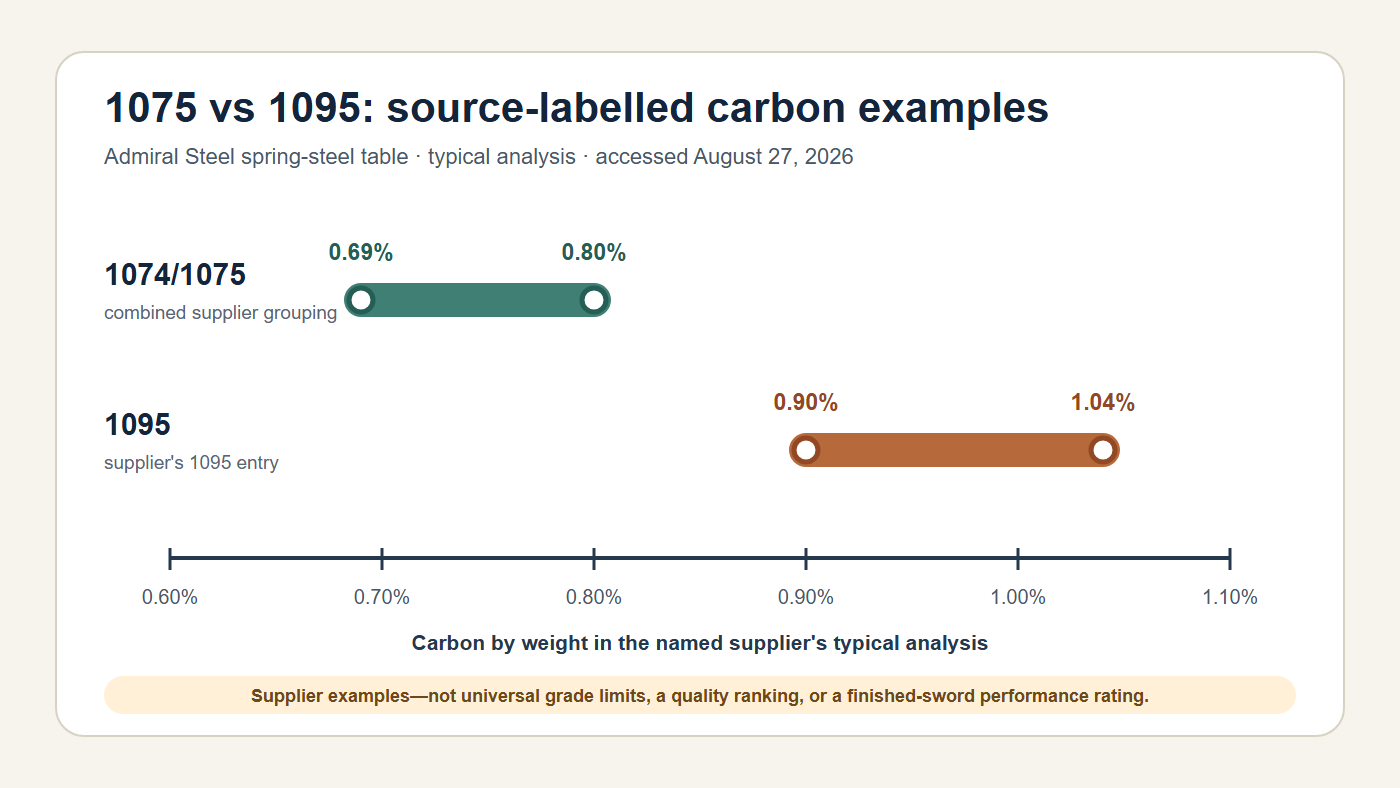
Supplier examples—not universal grade limits, a quality ranking, or a finished-sword performance rating.
What the grade number actually tells you
The short version is that 1075 and 1095 are names within a carbon-steel composition system. They help identify the material family and provide a starting point for technical discussion. They do not summarize everything that happened after the steel was produced.
For a concrete, source-labelled comparison, Admiral Steel’s spring-steel table lists:
- 1074/1075: typical carbon
.69–.80%and manganese.40–.80%; - 1095: typical carbon
.90–1.04%and manganese.30–.50%.
Notice the qualifiers: Admiral Steel, typical analysis, and the supplier’s named product grouping. Another producer may publish a nominal composition for its own product and form. For example, Alleima describes its 20C strip product as corresponding to ASTM 1095 and labels its chemistry in that producer-specific context. These records help explain a grade; they should not be blended into one supposedly universal recipe.
Why more carbon does not automatically mean a better sword
In the cited examples, 1095 has more carbon than 1075. That is a chemistry observation—not a buyer verdict.
It is tempting to turn the difference into a simple rule: 1075 is always tougher, or 1095 always holds an edge longer. This source record does not support either universal claim. To compare finished swords honestly, the material condition and the finished design also have to be known.
The National Bureau of Standards’ Heat Treatment and Properties of Iron and Steel explains the durable principle: heat treatment changes the condition and properties of steel. Cooling conditions, achieved microstructure and the section being hardened all matter. ASM International’s Heat Treating Subject Guide likewise treats composition, cooling and section size as connected variables rather than a grade-number shortcut.
That means two blades carrying the same grade label can still differ in important ways. The label alone does not report:
- the actual chemistry record for that batch;
- the heat-treatment process or achieved condition;
- blade thickness, width, distal taper or edge geometry;
- manufacturing defects or quality control;
- hilt and handle assembly;
- the activity the finished product was designed to perform.
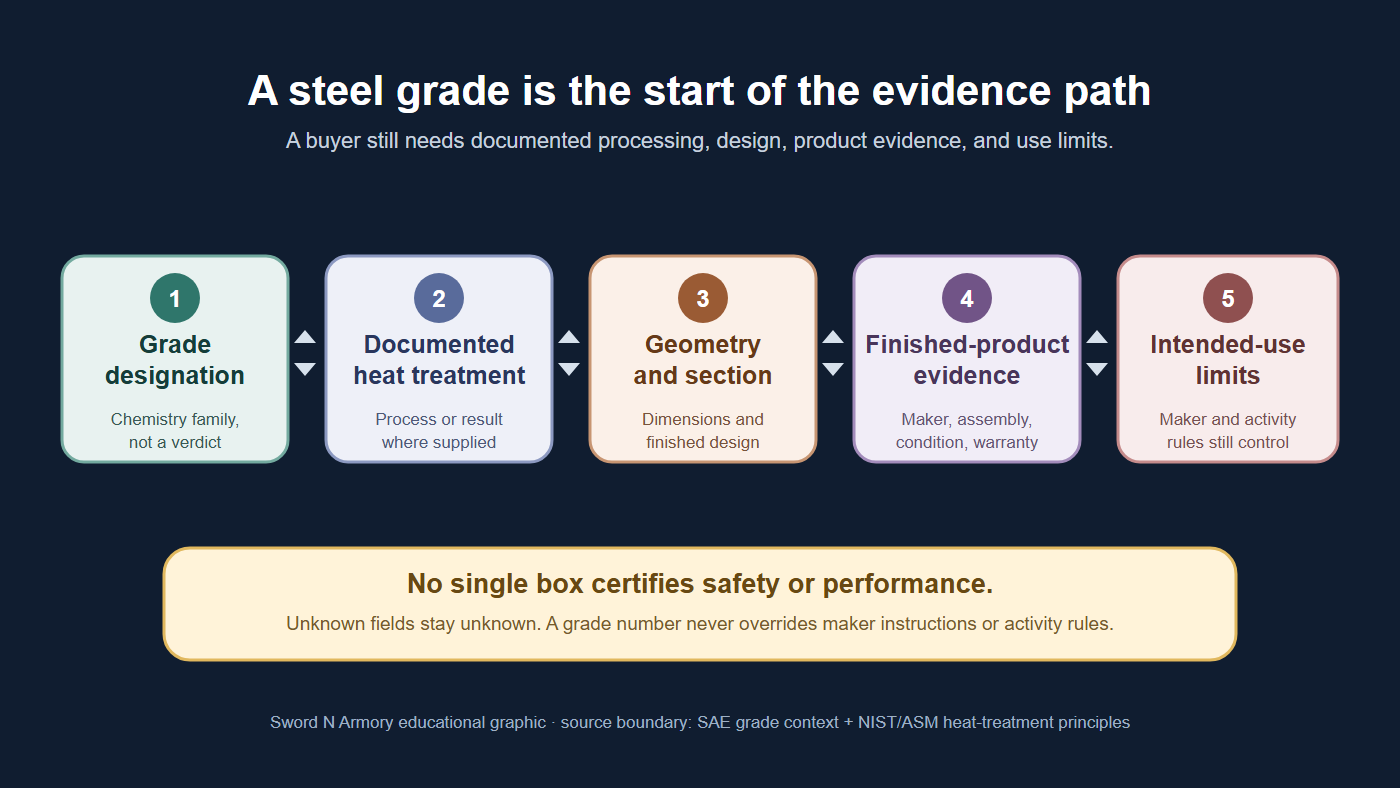
No single step certifies safety or performance; unknown fields remain unknown.
Heat treatment is part of the answer—but not a magic phrase
A listing may say through hardened or differentially hardened. Those descriptions can be relevant, but neither phrase is a universal certificate of quality or permission to use the sword in a particular activity.
Useful documentation should identify what the manufacturer actually supplies and what remains unknown. Avoid converting a process label into an unverified promise such as unbreakable, combat safe, best edge retention or ideal for any cutting. If a listing provides no heat-treatment information, the accurate entry is not supplied—not a guess based on the grade.
Compare finished-product evidence, not mythology
Before choosing between two swords, compare fields that belong to the exact products:
- Maker, model and SKU: Can the product be identified consistently?
- Material record: Is an exact steel designation supplied, and by whom?
- Heat-treatment information: What process or result does the maker state? What is not supplied?
- Blade geometry and dimensions: Are length, thickness, width, weight and other relevant measurements documented?
- Edge and point: Is the product sharp, blunt or unsharpened, and what does the maker permit?
- Assembly: How are the blade and hilt components constructed and secured for that design?
- Intended use and exclusions: Does the manufacturer name the permitted activity, targets or contact level?
- Instructions, inspection and warranty: What maintenance, stop-use conditions and exclusions apply?
- Evidence status: Which facts come from manufacturer documentation, seller records, independent testing or nowhere at all?
Missing information is not proof of poor performance, but it is still missing. Record it as unknown and ask the seller or manufacturer for written documentation instead of filling the gap with an assumption.
For a fuller intended-use checklist, read Battle-Ready vs Display Swords: What Buyers Need to Verify. That guide explains why battle-ready, functional, a sharp edge or a construction phrase cannot replace product- and activity-specific evidence.
A current SNA catalog example—and its limits
A retailer page can document what it currently says about its own product. It is not independent laboratory proof of durability, achieved hardness or performance.
At the time of this review, the Munetoshi Viper Unokubi 1075 katana page identifies Munetoshi, SKU JH-6311RD, 1075 spring steel, a through-hardened claim, a sharp edge, dimensions and stated light-target/tameshigiri use. These fields document visible page claims; they do not provide independent proof that every 1075 sword behaves alike or that this product outranks a 1095 sword. Follow the live product page, maker instructions and applicable training rules.
This example is intentionally one-sided: it demonstrates how to read documented fields, not how to stage an unsupported 1075-versus-1095 product contest.
Five common claims to reject
“1095 is always the better sword steel.”
Not established. The cited examples show a carbon difference, but better depends on the finished product, its documented condition and the buyer’s legitimate intended use.
“1075 is always tougher and 1095 is always brittle.”
Too broad. Without matched material condition, geometry and testing, neither universal outcome follows from the grade labels.
“A higher carbon number proves better edge retention.”
Not by itself. A grade number is not a finished-blade test result.
“Through hardened means battle-ready.”
No. A heat-treatment phrase does not certify intended use, assembly, condition or safety.
“The steel number tells me whether I can spar or cut.”
No. Use permission must come from the exact maker’s documentation and the rules of the activity. Do not use a sharp sword for sparring.
Which grade should a buyer choose?
Choose the better-documented finished product for the exact legitimate purpose—not the more impressive-sounding number.
- If two listings differ only in the grade number, there is not enough evidence to choose responsibly.
- If one listing documents the maker, heat treatment, geometry, assembly, intended use, limits, care and warranty while the other does not, the documentation difference is more actionable than a grade-number slogan.
- If a maker or activity rule does not permit your intended use, the steel grade does not override that restriction.
- If the evidence remains incomplete, ask for written documentation or do not treat the product as suitable for physical use.
Sources and review record
- SAE International, J403_202402 Chemical Compositions of SAE Carbon Steels.
- Admiral Steel, Spring Steel product table and 1074/1075 technical sheet.
- ASM International, SAE 1075, ISO CS75: Wrought High-Carbon Non-Alloy Steels and Heat Treating Subject Guide.
- Alleima, Alleima 20C / ASTM 1095 strip-steel datasheet.
- National Bureau of Standards, Heat Treatment and Properties of Iron and Steel.
Author: Sword N Armory Editorial Team Technical/editorial reviewer: Jacky, SwordNArmory Manager Review disclosure: This article received an internal store review by a SwordNArmory manager; it is not an independent external review. Last substantive update: August 27, 2026