
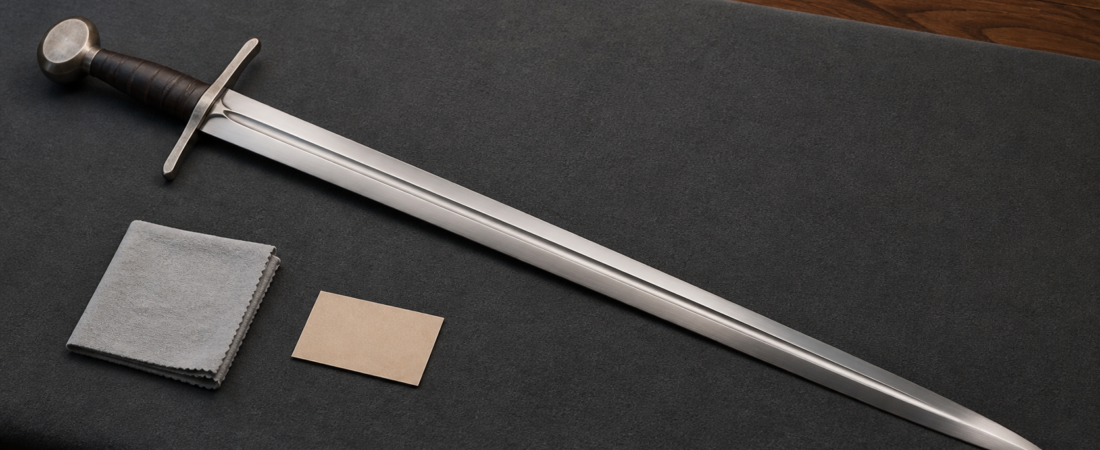
Direct answer: There is no universal cleaner, coating or calendar for every carbon steel sword. Before cleaning or oiling one, identify the exact maker and model, the blade’s material and finish, the hilt and scabbard materials, and the maker’s maintenance and warranty instructions. Stabilize the sword so the edge is controlled. Address moisture or contamination promptly with a method the maker permits, then inspect the exposed metal and its protective coating over time. If rust is spreading, bright orange, powdery, flaking or pitted—or if the finish or value is uncertain—stop experimenting and contact the maker or a qualified conservator or polisher.
Safety note: A sharp sword can cause severe injury during maintenance. CAS Iberia’s current guidance recommends working on a flat, stable surface, avoiding contact with the edge and never trying to catch a falling sword. Do not rely on gloves or a maintenance kit to make unsafe handling safe.
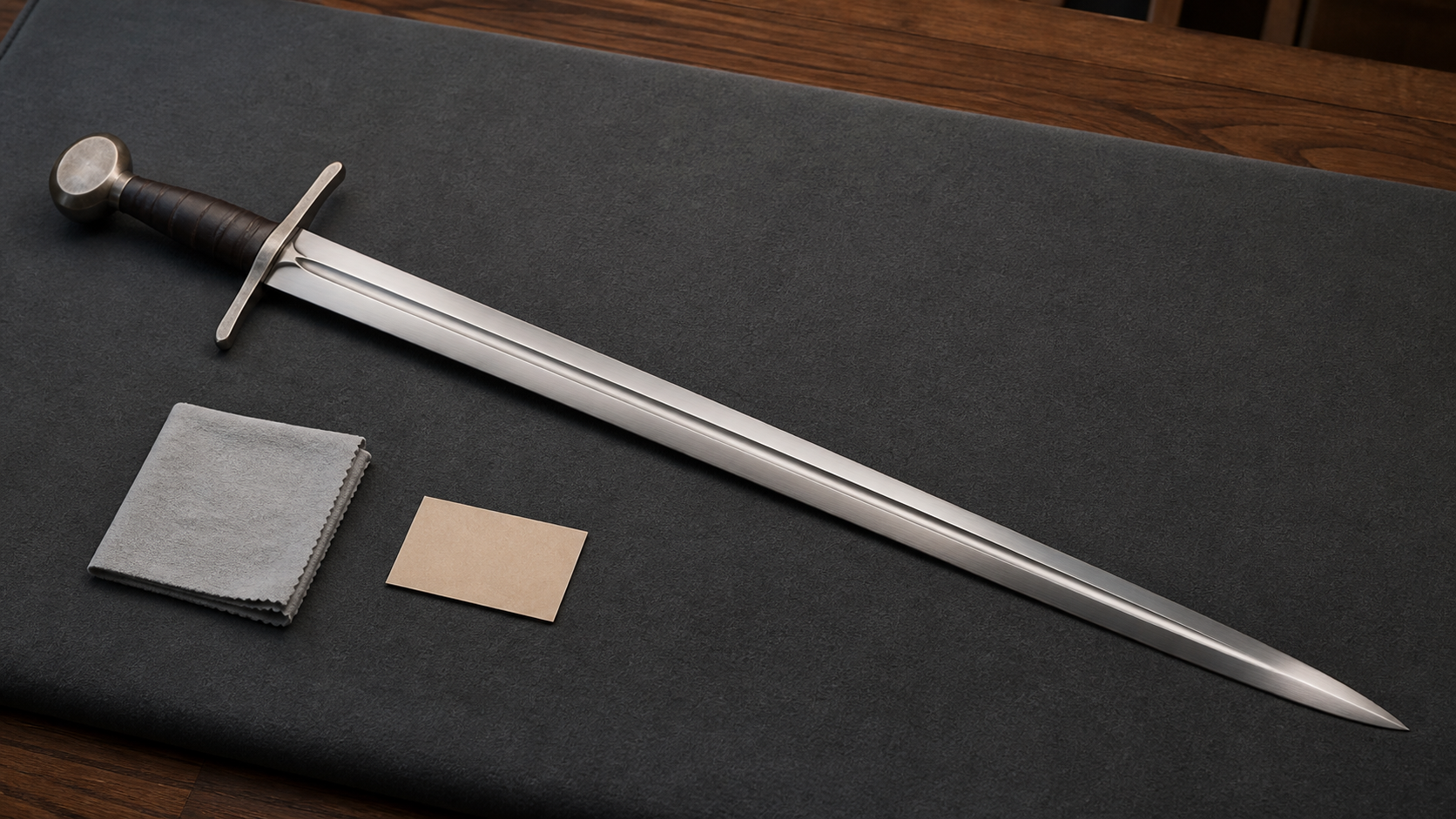
Original AI-assisted editorial image created for Sword N Armory; it is an inspection concept, not a product photograph or universal maintenance procedure.
Start by identifying the sword—not by choosing a cleaner
Carbon steel is not a complete care instruction. A sword can combine exposed steel with lacquer, paint, plating, etching, bluing or another surface treatment. Its hilt and scabbard may add wood, leather, textiles, adhesives and other materials that react differently to moisture, solvents, oils and very dry storage.
Before doing anything to the surface, write down:
- Maker, model and SKU: Can you locate the exact manual or product-care page?
- Blade and fittings: Which parts are exposed carbon steel, stainless steel, another metal, coated or plated?
- Finish: Is the blade polished, etched, blued, painted, lacquered or otherwise treated?
- Scabbard and hilt materials: Are leather, wood, lacquer, cord, rayskin or adhesives present?
- Condition and history: Was the sword just handled, used as permitted, exposed to moisture, or left in storage? Is the visible mark new or changing?
- Warranty and service boundary: Does the maker restrict disassembly, sharpening, abrasives, chemicals or unauthorized service?
If these facts are not available, the safest next step is usually to pause and ask the seller or manufacturer. Guessing from the steel number, the word katana, or the appearance of a maintenance product can damage a finish or compromise a warranty.
Why carbon steel sword parts can rust
Iron and steel corrode when environmental conditions support reactions involving moisture and oxygen. The Canadian Conservation Institute identifies liquid water, high relative humidity and contaminants such as salts and dust as important corrosion drivers. Skin contact can leave salts and oils on exposed metal, which is why makers commonly tell owners to inspect and care for a blade after handling.
This does not mean a fingerprint guarantees instant rust, or that one humidity number predicts every sword. Surface contamination, existing corrosion, coatings and the other materials assembled around the blade all change the risk. Ordinary carbon-tool-steel sword parts are not automatically stainless or stain-resistant, but carbon percentage alone does not rank the corrosion resistance of finished swords.
For the difference between a steel grade and finished-blade behavior, see 1075 vs 1095 Steel for Swords: What the Grade Does—and Doesn’t—Tell You.
Choose the care path that matches what happened
| Situation | First decision | General boundary |
|---|---|---|
| The exposed metal was touched | Check the surface and maker instructions | Remove contamination and renew protection only with a compatible method. |
| The sword was used as the maker permits | Inspect the full accessible surface for moisture, debris, coating loss or damage | Follow the exact after-use procedure; do not improvise sharpening or disassembly. |
| The sword became wet or was in a damp place | Control the edge and address moisture promptly | Avoid driving liquid or chemicals into the hilt, scabbard or finish; contact the maker when access is uncertain. |
| The sword has been stored | Inspect the coating, metal and surrounding materials | Use condition and maker guidance—not a universal calendar—to decide whether care is due. |
| A new orange, powdery, flaking or pitted area appears | Document it and determine whether it is changing | Stop aggressive DIY treatment; seek maker or professional advice when active, extensive, valuable or finish-sensitive. |
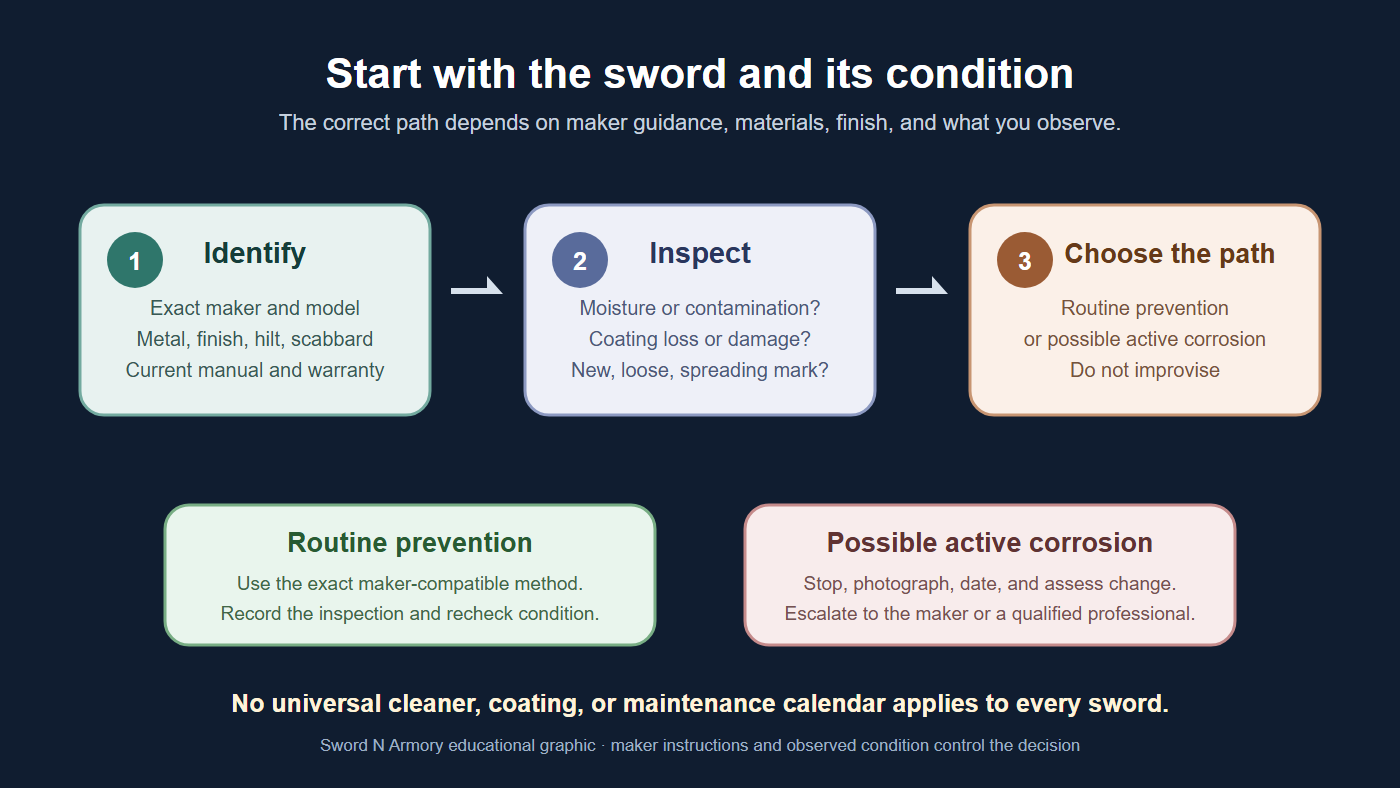
Maker instructions and observed condition control the path; no universal cleaner, coating or calendar applies to every sword.
A bounded routine for prevention
The steps below are a decision framework, not a universal product recipe.
1. Make the work area stable
Keep other people away, support the sword on a stable surface and position the edge so it is not facing your hands or body. Do not work while distracted, and never attempt to catch a falling blade.
2. Inspect before wiping
Look over accessible metal, the existing protective layer, the junctions with other materials and the inside edge of the scabbard opening without disassembling the sword. Photograph any mark you want to track. A dated photograph is useful for deciding whether a spot is stable or changing, but it does not replace inspection by the maker or a conservator.
3. Use only a compatible cleaning method
Follow the exact maker’s instructions for removing fingerprints, ordinary residue or shipping protection. Do not assume that lacquer thinner, alcohol, WD-40, an acid, a polishing powder, steel wool or another abrasive is safe merely because an old article or product listing mentions it. A method that a maker specifies for one bare-steel finish can scratch, stain, lift or dull another surface.
4. Leave the surface dry and appropriately protected
Makers commonly call for a light protective layer on exposed carbon steel, but they do not publish one universal product list. Use only the coating and application method approved for the exact sword. More is not necessarily better: excess material can migrate into wood, leather, lacquer, adhesives or the scabbard and can trap debris.
5. Record the inspection rather than trusting memory
Note the date, why the sword was inspected, what you observed and what maker-approved action was taken. Recheck any uncertain mark. This condition record is more useful than blindly repeating a weekly or monthly ritual.
Why there is no universal maintenance interval
Current maker instructions illustrate the problem with one calendar rule:
- CAS Iberia’s general sword guidance calls for cleaning and recoating after use and regular inspection when a sword is stored in its scabbard.
- CAS Iberia’s katana guidance gives its own maintenance timing and calls for care after the blade is touched.
- Albion tells owners of its swords to care for the metal after handling or cutting and after a stated storage/display interval.
- Arms & Armor recommends wiping its weapons after handling and periodically checking and renewing protection.
These are not votes to be averaged. They describe different products, finishes and maker expectations. For your sword, the controlling answer is the exact maker’s current instruction plus the observed condition and storage environment. More frequent inspection may be warranted after handling, permitted use, moisture exposure, coating loss or environmental change.
Scabbards, saya and long-term storage
Always store it in the scabbard and never store it in the scabbard are both too broad.
Arms & Armor warns owners of its weapons that leather sheaths can retain moisture and advises against storing its steel blades in them. CAS Iberia instead tells owners who store a sword in its scabbard for an extended period to inspect the protective coating regularly. Its katana guidance also treats the lacquered saya and horizontal edge-up storage as parts of a specific system.
The correct rule is conditional:
- identify whether the scabbard is leather, lacquered wood or another construction;
- follow the maker’s storage orientation and coating instructions;
- avoid putting a damp or contaminated blade into storage;
- inspect both the accessible metal and the scabbard for moisture, debris, damage or changing fit;
- do not pour oil or another treatment inside a scabbard unless the maker explicitly directs it for that construction.
Very dry conditions are not automatically ideal for the entire sword. Conservation guidance notes that low humidity benefits bare metal, while organic parts in a composite object can crack, split, lift or deform when kept too dry. Avoid damp and rapid environmental changes, but do not impose a museum-style microclimate or desiccant system on a mixed-material sword without qualified guidance.
Is the mark active rust?
The Canadian Conservation Institute distinguishes stable surface corrosion from signs of active change. New bright orange areas, powder, flakes, expanding pits or loose corrosion products are warning signs that may indicate active corrosion and merit closer evaluation. A stable patina is different: colour alone is not enough for an online diagnosis, and an old or intentionally preserved surface should not be treated automatically as dirt to remove.
If a mark appears:
- stop handling the affected surface;
- photograph and date it;
- check whether it is new, loose, spreading or associated with moisture;
- review the maker’s service instructions and warranty;
- contact the maker or a qualified conservator/polisher when corrosion is active or extensive, the blade is valuable or historic, or the finish is uncertain.
This guide deliberately does not provide acid, electrolysis, generic chemical remover, sanding or polishing instructions. Those actions can remove metal, alter geometry, erase etching or patina, damage coatings and make a repair harder to evaluate.
Sharpening and disassembly are separate jobs
Routine care is not authorization to sharpen a blade, remove a hilt, drive out pins or repair a scabbard. CAS Iberia warns against katana disassembly without formal training, and its product FAQ treats sharpening of high-end katana as a trained-service question. Cold Steel’s current warranty is one example of a maker excluding damage associated with misuse, insufficient normal maintenance, alteration or disassembly. Other makers set their own terms.
If the edge, hilt fit, scabbard fit or hidden surface needs work, identify the maker-approved service route. Do not convert a maintenance article into a sharpening or restoration manual.
Owner checklist
Routine prevention
- ☐ Exact maker/model and current manual located.
- ☐ Blade material and finish identified.
- ☐ Hilt and scabbard materials identified.
- ☐ Sword stable; edge controlled; work area clear.
- ☐ Surface inspected before cleaning; uncertain marks photographed.
- ☐ Only maker-compatible cleaning/protection selected.
- ☐ No unapproved abrasive, acid, electrolysis, solvent, sharpening or disassembly.
- ☐ Storage area checked for damp, contaminants and rapid environmental change.
- ☐ Scabbard storage follows the exact maker/construction guidance.
- ☐ Maintenance date and observations recorded.
If corrosion may be active
- ☐ Handling of the affected surface stopped.
- ☐ The mark photographed, dated and checked for new powder, flakes, spreading or pitting.
- ☐ Active, extensive, valuable or uncertain corrosion escalated instead of improvised.
- ☐ No generic remover, abrasive, acid, electrolysis, sharpening or disassembly attempted.
Review and editorial disclosure
Technical/editorial reviewer: Jacky, SwordNArmory Manager Review disclosure: This article received an internal store review by a SwordNArmory manager; it is not an independent external review. The reviewer approved the source-controlled editorial draft with no substantive comments.
Sources and scope
This guide uses current manufacturer guidance from CAS Iberia, CAS Iberia’s katana guidance, Albion Swords and Arms & Armor. General corrosion and conservation boundaries come from the Canadian Conservation Institute’s Caring for metal objects and Basic care – Iron objects. The warranty example comes from Cold Steel.
Manufacturer examples apply to their products. Conservation guidance helps establish mechanisms and stop conditions; it does not replace a product manual. Sword N Armory is a retailer, and this article does not certify product compatibility, safety, restoration outcome or warranty coverage. No Sword N Armory maintenance-category or product link is included while compatibility remains unverified.