
FIELD NOTE 01
The joining method is the fastest reliable clue.
In a brigandine vs lamellar armor comparison, start with how the plates connect. Brigandine fastens small plates to a strong fabric garment with rivets. Lamellar joins its plates directly to one another with lacing.
That distinction identifies a construction family—not a universal combat winner.
THE SHORT ANSWER
Riveted garment versus laced plate assembly.
Both systems use many small plates. In brigandine, the garment carries them. In lamellar, plate-to-plate lacing carries the structure. Period, region, materials, fit, padding, intended activity, and organizer rules matter more than a winner chart.
READ THE CONSTRUCTION
Brigandine vs lamellar armor: two systems, one decisive difference
Plates belong to the garment
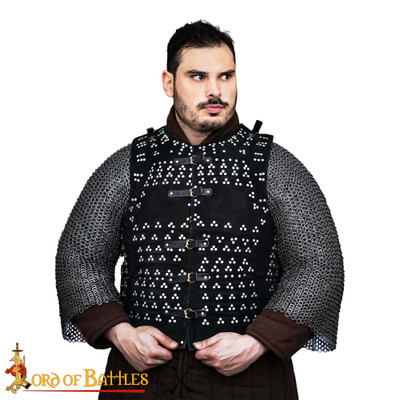
Small plates are riveted to fabric layers. Most metal can sit behind textile while rivet heads remain visible.
- Support
- Fabric garment
- Joining
- Rivets
- Clue
- Textile + rivet pattern
Plates belong to one another
Perforated plates are laced to neighboring plates in overlapping rows, supplying their own structural network.
- Support
- Plate-to-plate lacing
- Joining
- Cord or leather
- Clue
- Rows + exposed lacing
The Met and British Museum document small plates riveted to fabric in surviving brigandines. Met object · British Museum object
The Met's Tibetan lamellar defense joins plates and rows through leather lacing without requiring internal support fabric. Met lamellar object
PLACE BEFORE LABEL
History is wider than an East/West shortcut
The Italian Met fragment is dated 1400–1450; the British Museum example is dated about 1500–1530. The Met distinguishes fabric-covered coats of plates from later brigandines. Met essay
Lamellar spans wider geography and chronology. The Met's Tibetan defense and Royal Armouries' Asian example show range, but do not justify calling every exposed row “Viking,” “Mongol,” or “Samurai.” Royal Armouries
Historical accuracy starts with a defined place, date range, role, and evidence—not the word “medieval.”
EVIDENCE LIMIT
The sources do not name a universal combat winner
Royal Armouries says the laced, overlapping plates of its example form a tough, flexible defense that helps deflect and absorb arrow impact. That is an object-level description, not a matched test against brigandine.
The accepted sources do not establish universal rankings for repair, breathability, cuts, thrusts, arrows, blunt force, or overall superiority.
Performance depends on plate material and thickness, geometry, overlap, coverage, joining condition, fit, padding, and threat. Historical appearance is not protective certification.
BUYING & RECONSTRUCTION
Choose from the impression outward
- 01Define the place, date range, role, and social context.
- 02Verify material, thickness, overlap, joining, backing, and coverage.
- 03Measure over the clothing and padding you will actually wear.
- 04Match display, costume, LARP, reenactment, or rules-governed contact use.
- 05Check the organizer's current equipment and inspection rules.
For more evidence-led buying frameworks, browse the Sword N Armory Guides.
MODERN EXAMPLES
See the construction in current listings
Product pages illustrate modern products; they do not establish the historical claims above or certify contact use.

Renaissance Canvas Brigandine
18-gauge steel plates riveted between canvas layers; adjustable side straps.
15th Century Leeds Brigandine
Mild-steel plates riveted beneath suede; verify your organizer's current rules.
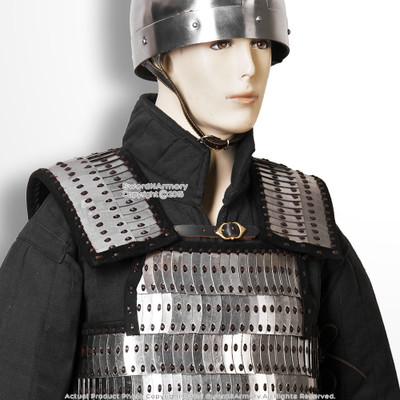
Steel Lamellar Body Armor
Punched and laced 20-gauge steel plates. The product page limits use to LARP and cosplay.
QUICK ANSWERS
Frequently asked questions
Is brigandine the same as lamellar?
No. Brigandine plates are riveted to a garment; lamellar plates are laced to one another.
Does lamellar need fabric backing?
Not as its primary structural support. Clothing or padding may still sit beneath it.
Is this simply Europe versus Asia?
No. Use dated regional evidence for the specific impression.
Which is safer for modern combat?
The label cannot answer that. Follow the organization's equipment rules and inspection process.
What should I check before buying?
Intended use, sizing, construction, coverage, care, returns, and event rules.
PRIMARY REFERENCES